“Chekhov’s early stories are his springtime: touching, stormy, full of joie de vivre, with flashes of sunlight, mischievous breezes and an ironic kaleidoscope of Russian faces. His grey, twilit, heart-wrenching autumn is still ahead, so rejoice in Chekhov’s springtime!”Vladimir Sorokin, author
Projects / Early Chekhov
Translation and publication
Early Chekhov
The first comprehensive annotated English edition of Chekhov’s earliest stories, brought together through an international volunteer translation project.
Launched in 2014, the project drew on the work of 85 volunteers from nine countries. The resulting volume includes 58 stories written between 1880 and 1882.
The story behind the book
Early Chekhov Translation Project
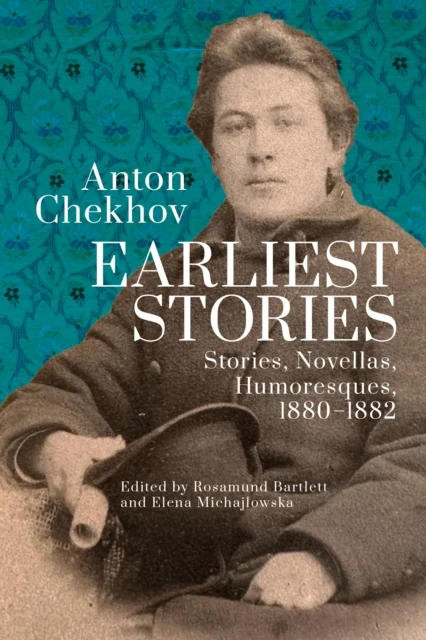
When we launched the Early Chekhov Translation Project in 2014, our aim was to produce the first comprehensive annotated edition of Chekhov's earliest stories in English for the benefit of readers worldwide. Hundreds of pages and over 150,000 words later, all translated and edited by our team of 85 dedicated volunteers from 9 different countries, we are pleased to announce the results of this unique international collaboration. The resulting volume, Anton Chekhov. Earliest Stories. Stories, Novellas, Humoresques, 1880–1882, was released in November 2025. Accompanied by a comprehensive introduction and explanatory notes, the book is published by Cherry Orchard Books, an imprint of Academic Studies Press based in Boston, and is available from booksellers including Blackwell's.
The volume's 58 stories were all written between 1880 and 1882, when Chekhov was in his early twenties, and still at medical school. They make up volume 1 of the 10 volumes of short stories in the authoritative thirty-volume Academy of Sciences edition of Chekhov’s Complete Collected Works. The resulting English translations have been arranged in chronological order as in the original Russian edition.
History of the project
The sixty classic short stories Chekhov wrote after he made his debut in a prestigious literary journal with "The Steppe" in 1888 are well-known in English. This is not the case with much of what he wrote before that date, however, particularly the works which date from the outset of his career. During the eight years of Chekhov’s literary apprenticeship, when he was writing principally to earn money to support his impoverished family, he wrote 528 stories, novellas, sketches and vignettes.
Constance Garnett included 144 of them in the pioneering 13-volume edition of Chekhov’s short stories she published between 1916 and 1922. A number of others have been translated since then in disparate volumes, but a great many are still unknown to English-speaking readers.
Chekhov fans may be pleasantly surprised to discover that his early work is not quite what they were expecting. His early stories encompass a huge range of characters from a wide variety of backgrounds, including historical figures, and embrace many different genres and styles, some of them even quite racy, but they all feature Chekhov's inimitable touch.
We hope that our volume of often uproarious comic stories will shed light on the making of Chekhov as a writer, and be a useful and enjoyable resource for scholars, actors, directors, and enthusiasts alike. Many of the stories lend themselves naturally to dramatisation, and in due course the Anton Chekhov Foundation plans to find ways to explore this possibility through partnerships with drama colleges, radio, theatre companies and film producers.
We are particularly keen to involve young actors and directors in any planned performances.
The Early Chekhov Translation Project was formally launched in December 2014 in London W1. The evening featured three sketches from Cabaret Chekhov performed by final-year students from the Rose Bruford College of Theatre and Performance. The sketches, all dramatisations other early Chekhov stories translated by ACF Trustee Rosamund Bartlett, were first performed with a musical accompaniment at the Edinburgh Fringe in 2010 under the direction of Michael Earley, then Principal of Rose Bruford College.
An important aim of our project was to make it as inclusive as possible The Anton Chekhov Foundation thus invited professional and aspiring translators of all ages and backgrounds to participate, by each choosing a story. The response was so enthusiastic that the entire volume was assigned within the space of a few weeks.
As well as individual translators, the project attracted several translators working in pairs and in groups, from countries as far flung as Australia, New Zealand, the United States, Canada, the Netherlands, Sweden and Bulgaria, as well as England and Ireland. They ranged from pupils studying Russian in secondary schools to university students, professional translators, enthusiastic amateurs, and retired academics.
We will soon be publicising on our website a selection of translators' biographies, based on their permission.
Our volunteer translators were able to access the stories they had selected online. As with everything else Chekhov wrote, they have all been digitised and are freely available via scholarly sites such as the "Fundamental Digital Library of Russian Literature and Folklore" (Fundamental'naya Elektronnaya Biblioteka Russkoi Literatury i Fol'klora).
This particular repository of primary and secondary texts was established in 2002 to "provide the global scholarly community and any interested individuals free and unfettered access "to the major works of Russian literature, as well as provide a resource for education in the humanities at all levels. Once all the first drafts had been submitted, translators were invited to engage in a peer-review process.
Amanda Calvert, a professional translator, then generously volunteered to read through the entire volume, bringing her experience of living and working in Moscow for thirty years to her thoughtful suggested revisions.
In 2019, Anton Chekhov Foundation trustees Rosamund Bartlett, a native English-speaking Chekhov specialist and translator, and Elena Michajlowska, a native Russian-speaking long-term UK resident with an MA in Screenwriting from a British university and an in-depth knowledge of Chekhov, were finally able to begin the next round of editing.
After first reviewing each translation individually, they proceeded to work through them together, reading every word aloud and discussing linguistic and stylistic issues in detail. In the autumn of 2021, the Anton Chekhov Foundation began moving to the next stage of the project: final editing, and investigation of means of wider dissemination through publication.
Given the size of the volume it took some time to find a suitable publisher, ready to take on the project in its entirety and not just “The best of…”. Finally, in spring 2023 the Anton Chekhov Foundation signed a publishing contract with Cherry Orchard Press, and the editors, Rosamund and Elena, started working on preparing the manuscript, footnotes and comprehensive explanatory endnotes for the publication.
About the book
What readers say
Writers, performers and scholars respond to Chekhov’s earliest fiction and the international translation project behind this edition.
“Absurd, zany, mordant and melodramatic—these stories are full of surprises, and are the perfect antidote for anyone who still thinks of Chekhov as gloomy.”Geraldine James, actress
“This international, invigorating, and in many ways utopian translation project brings a wealth of voices, tones and nuances to Chekhov’s early stories.”Sasha Dugdale, poet, playwright and translator
“Chekhov’s Earliest Stories: Stories, Novellas, Humoresques 1880–1882, edited by Rosamund Bartlett and Elena Michajlowska, is a landmark publication. The perennial, deep engagement with Chekhov has burgeoned in recent decades: adaptations of his works abound. Is there any other writer, except perhaps Shakespeare, who continuously reinvents the world the way Chekhov does? Yet many of his early works have never been translated into English, and this is the first complete translation of all his very earliest stories, accompanied by helpful annotations. Bartlett, a foremost English translator-scholar worldwide, has written a groundbreaking introduction brimming with vital new information and insight. She and her distinguished colleague Michajlowska have assembled a dazzling international team of 83 translators to give us this uniquely precious collection. Chekhov virtually leaps off the pages in these often absurd, edgy, funny but always keenly observed earliest works.”Robin Feuer Miller, Edytha Macy Gross Professor of Humanities and Professor of Russian and Comparative Literature, Brandeis University
Further reviews
Cathy Popkin, Jesse and George Siegel Professor in the Humanities, Department of Slavic Languages, Columbia University“In this groundbreaking edition of Chekhov’s earliest publications (1880–1882), Rosamund Bartlett and Elena Michajlowska make available in English the full complement of stories, sketches, and humoresques included in volume 1 of the definitive scholarly edition of his work. Given that most English-language collections of Chekhov’s prose feature his later, more widely known stories, this volume provides an invaluable resource for scholars, writers, and general readers alike.
This alone would have been enough. But in her astute introduction Bartlett also provides a riveting discussion of how the history of publication and republication of individual works, combined with the serial revisions and rewritings undertaken by Chekhov himself and compounded by the eventual compilation and recompilation of an authorized Collected Works, which grew (in the years after Chekhov’s death) from the original ten to an eventual twenty-two volumes, vastly complicate the matter of dating and chronology. Add to the proliferation of versions in Russian the further complications introduced by serial translations of this or that story in this or that version tagged with this or that date—and, as it turns out, even the scholarly thirty-volume edition contributes to this chronological jumble. In this context, earliness itself merits scrutiny.
The volume’s fifty-eight stories have been brought into English by a collaborative of eighty-three translators from nine countries. Each began working on a single text, then went on to participate in a recursive process of crowd translation. The work proceeded so collaboratively and the process ultimately proved so productive that the results are credited to the collective as a whole. The English versions are thus beautifully coherent—yet they are also stylistically divergent, as demanded by Chekhov’s take-offs on a stunning range of speech acts and genres: letters, testimony, statistical tables, speeches, catalogues, excerpts, almanacs, and more. The stories themselves are quite wonderful, and these new translations represent a tremendous achievement.
Finally, Bartlett’s editorial apparatus deftly makes sense when clarification is required or a private joke needs explaining. She has shrewdly placed immediate sense-making notes at the bottom of the page, with more extensive background information at the end of the volume; the format itself makes the book both maximally accessible and a great pleasure to read.”
“What a gift to readers of Chekhov: the most comprehensive edition of his earliest fiction in English! Assembled through the collaborative efforts of more than eighty translators, this remarkable volume is an outstanding collective achievement. Chekhov’s early creations reveal a side that may surprise those who know only his mature works: irreverent, versatile, brimming with raw energy, and often uproariously funny. Read together, they offer a fresh insight into how the future master of subtle understatement was finding his voice. Kudos to the indefatigable Rosamund Bartlett and her tireless team of translators for bringing this treasure to light. For any lover of Chekhov, this book overflows with delights, discoveries, and revelations. A second volume, please!”Radislav Lapushin, Associate Professor, University of North Carolina at Chapel Hill
“This is the definitive English text of Chekhov’s beginnings, the best window we have into the first three years of his career. If Chekhov had known, in his early twenties, that the half-baked pieces he was sending out to cheap periodicals would one day be treated with such consummate editorial care, in a volume culled from the collective international work of almost a hundred translators and scholars, he would likely have been delighted, amused, and mortified. And so are we, reading him at his most unguarded.”Yuri Corrigan, Associate Professor of Russian and Comparative Literature, Boston University